

Choosing the right clinical trial sites in Latin America is a crucial step that can significantly impact the success of research initiatives. The region's rich tapestry of diverse healthcare systems, regulatory environments, and cultural dynamics presents both unique opportunities and challenges for researchers. As the demand for clinical trials continues to grow, understanding how to navigate these complexities becomes essential for optimizing outcomes.
What strategies can sponsors employ to ensure effective site selection and enhance participant recruitment in this vibrant landscape? This question is not just relevant; it is imperative for those looking to thrive in the competitive field of clinical research.
Choosing research sites for clinical trial site selection in Latin America is crucial for successful clinical research, demanding a nuanced understanding of the regional landscape. This includes healthcare infrastructure, regulatory environments, and cultural factors unique to each nation. The region boasts a diverse array of patient groups and varying degrees of healthcare access, which can significantly impact study execution. For example, Brazil and Mexico are recognized for their robust clinical research infrastructures, which support clinical trial site selection in Latin America and facilitate efficient study processes. Conversely, some countries may encounter challenges such as limited resources or slower regulatory approvals, which can impede progress.
Understanding these regional differences is essential for effective clinical trial site selection in Latin America, aligning research objectives with local capabilities and ultimately enhancing the likelihood of successful outcomes. Engaging with local experts and stakeholders can provide invaluable insights into these dynamics, leading to more effective clinical trial site selection in Latin America and management strategies. As of 2026, Colombia's regulatory environment stands out, featuring a level-4 regulatory agency that ensures high standards for research, making it an attractive location for international studies. Additionally, Colombia's recent introduction of a 50% tax credit for R&D expenses further incentivizes foreign investment in research, which enhances clinical trial site selection in Latin America, positioning the nation as a key player in the Latin American research market.
bioaccess® offers comprehensive management services for studies, including:
These services can significantly enhance the effectiveness and success of research in this region. Overall, Latin America contributes approximately 10% of global medical research, underscoring its vital role in the international studies market.

Choosing clinical trial site selection in Latin America requires a thorough assessment of several critical elements that can significantly impact trial outcomes. Key considerations include:
For example, LATAM contributed 2,609 locations, representing 8.8% of the total, with Brazil alone accounting for 1,194 locations. A site with a proven track record of successfully enrolling participants in similar studies is more likely to meet recruitment targets, making historical performance a vital metric. Moreover, the proximity of the location to potential participants can enhance recruitment efficiency.
Adhering to local regulatory requirements is also essential, as it ensures smooth operations. As Monica Mora, Chief Operating Officer, emphasizes, streamlining processes to facilitate regulatory approvals is crucial for optimizing patient recruitment strategies. Additionally, evaluating logistical capabilities-such as access to transportation, facilities for data collection, and the site's historical performance metrics-can simplify processes and boost overall efficiency.
Significantly, bioaccess's partnership with Caribbean Health Group aims to enhance clinical trial site selection in Latin America by positioning Barranquilla as a premier destination for clinical studies, supported by Colombia's Minister of Health. This initiative underscores the importance of local collaborations in enhancing testing capabilities. By carefully assessing these factors, sponsors can make informed decisions that greatly improve the likelihood of success in their trials.

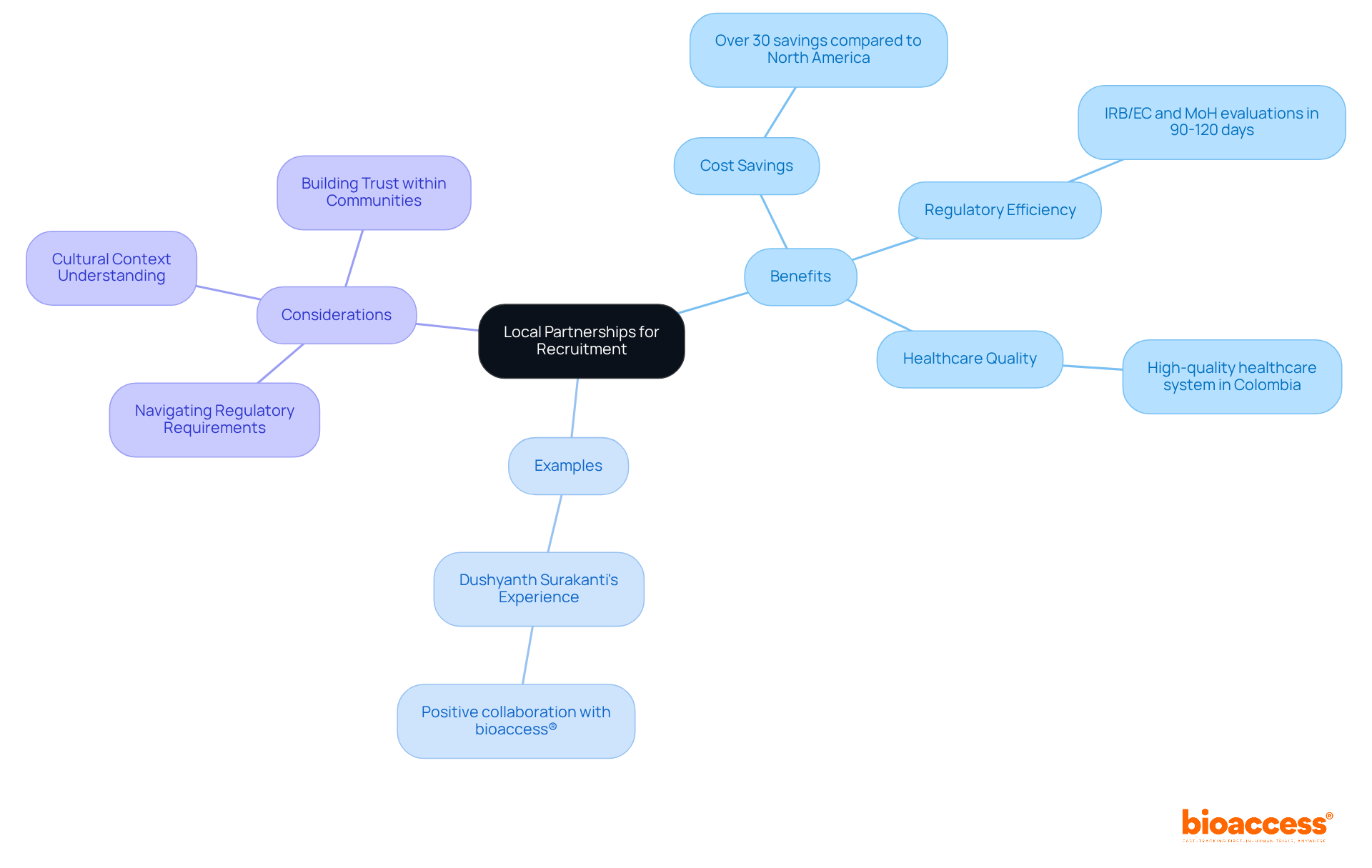
Establishing robust local collaborations is essential for improving participant recruitment in clinical trial site selection in Latin America. By partnering with local healthcare providers, community organizations, and advocacy groups, researchers can improve access to diverse populations and foster trust within the community. For example, collaborating with local physicians who grasp the cultural context and healthcare needs of their patients can lead to more effective recruitment strategies.
Dushyanth Surakanti, Founder and CEO of Sparta Biomedical, shared his positive experience with bioaccess® during its initial human study in Colombia, underscoring the importance of local collaboration. Colombia offers competitive advantages for first-in-human studies, including:
These partnerships not only facilitate navigation of regulatory requirements but also ensure compliance with local laws, which can vary significantly across countries.
By leveraging regional knowledge and connections, sponsors can enhance their recruitment initiatives during clinical trial site selection in Latin America, shorten timelines, and ultimately improve the quality of research data. As you consider your own challenges in clinical research, think about how local collaborations could transform your recruitment strategies.
Incorporating technology and data analytics into clinical trial operations is crucial for enhancing efficiency and optimizing outcomes, especially with bioaccess®'s capabilities. Tools like electronic data capture (EDC) systems, registries, and predictive analytics streamline data collection and improve recruitment strategies. For instance, bioaccess® enables sponsors to recruit treatment-naive cardiology or neurology groups 50% faster than in Western locations, leading to savings of $25K per individual with FDA-ready data - no rework, no delays. By leveraging data analytics to pinpoint patient demographics and historical recruitment patterns, sponsors can effectively target the right clinical trial site selection in Latin America and the appropriate populations.
Moreover, technology facilitates remote monitoring and decentralized study designs, which are increasingly vital in the context of clinical trial site selection in Latin America. By harnessing these advancements, bioaccess® empowers sponsors to reduce operational costs, enhance data quality, and accelerate the overall trial timeline. This integration of technology not only addresses key challenges in the Medtech landscape but also underscores the importance of collaboration in driving successful clinical outcomes.

Selecting clinical trial sites in Latin America is not just a task; it’s a pivotal process that can dictate the success of research initiatives. Understanding the regional landscape is crucial. By evaluating key factors, leveraging local partnerships, and utilizing technology, researchers can refine their site selection strategies and significantly enhance trial outcomes.
Several critical elements influence successful clinical trial site selection in Latin America:
In summary, the importance of effective clinical trial site selection in Latin America cannot be overstated. By integrating these best practices, researchers can enhance the efficiency of their studies and contribute to the advancement of medical research in the region. Embracing local insights and technological innovations will pave the way for successful clinical trials, ultimately benefiting patients and the broader healthcare landscape.
Why is understanding the regional landscape important for clinical trial site selection in Latin America?
Understanding the regional landscape is crucial because it involves recognizing healthcare infrastructure, regulatory environments, and cultural factors unique to each nation, which can significantly impact study execution and outcomes.
Which countries in Latin America are known for their strong clinical research infrastructures?
Brazil and Mexico are recognized for their robust clinical research infrastructures that support clinical trial site selection and facilitate efficient study processes.
What challenges might some Latin American countries face in clinical trial site selection?
Some countries may encounter challenges such as limited resources or slower regulatory approvals, which can impede progress in clinical trials.
How does Colombia's regulatory environment enhance its attractiveness for clinical trials?
Colombia features a level-4 regulatory agency that ensures high standards for research, and it has introduced a 50% tax credit for R&D expenses, making it an attractive location for international studies and enhancing clinical trial site selection.
What services does bioaccess® offer to improve the effectiveness of clinical research in Latin America?
bioaccess® offers services including feasibility assessments, location selection, compliance evaluations, study setup, import permits, project oversight, and reporting to enhance the effectiveness and success of research.
What percentage of global medical research does Latin America contribute?
Latin America contributes approximately 10% of global medical research, highlighting its vital role in the international studies market.