

Latin America is rapidly emerging as a compelling hub for Medtech clinical trials. This transformation is driven by a unique combination of accelerated ethics approvals, cost-effective solutions, and access to diverse patient populations. Not only does this region offer significant financial advantages - potentially reducing trial costs by up to 30% - but it also boasts a robust healthcare infrastructure that enhances the quality of research outcomes.
However, as Medtech firms consider the opportunities presented by this vibrant landscape, they must navigate the complexities of regulatory frameworks and patient recruitment challenges.
What are the key benefits that make Latin America an attractive destination for clinical trials?
How can stakeholders leverage these advantages to drive innovation in healthcare?
By addressing these questions, we can better understand the potential of this region in advancing clinical research.
In Latin regions, ethics approval timelines can be as short as 4-8 weeks, a stark contrast to the typical 3-6 months seen in the US and EU. This rapid approval process is driven by streamlined regulatory frameworks, such as those governed by INVIMA, and a strong commitment to enhancing research efficiency. For Medtech firms, this means quicker access to research study initiation, allowing for faster data collection and product development.
Colombia, in particular, stands out with savings of over 30% compared to trials in North America or Western Europe. Its healthcare system is ranked among the best globally, further boosting its appeal. Recent partnerships involving bioaccess® have shown that companies can secure regulatory approval in as little as six weeks, significantly improving their ability to introduce innovative solutions to the market. Additionally, Colombia offers R&D tax incentives that provide substantial financial benefits for companies investing in medical research.
Dr. Ana Maria Valderrama, Executive Director of Development Operations at Pfizer, notes, "Countries in South America function more and more in line with international standards and guidelines," which enhances the region's attractiveness for research trials. As the area continues to update its regulatory framework, the advantages for medical research become increasingly clear, positioning this region as a pivotal location for Medtech studies.

Conducting medtech clinical trials in Latin America offers substantial cost reductions, with expenses potentially lowered by as much as 30% compared to studies in the US or Europe. This financial advantage arises from several key factors:
For instance, Medtech firms have effectively leveraged these advantages in conducting medtech clinical trials in Latin America, enabling them to perform numerous experiments concurrently while optimizing their budgets.
Consequently, the average expense of research studies in the region is projected to be around $1.5 million per project in 2024, making it an attractive option for innovative healthcare companies. Moreover, the evolving regulatory environment and the presence of diverse patient groups enhance the practicality and effectiveness of medtech clinical trials in Latin America, solidifying the region's reputation as a premier location for research trials.
As you consider your own challenges in clinical research, think about how these factors could impact your next project. The collaboration between local entities and international firms can pave the way for groundbreaking advancements in healthcare.

Latin America boasts a rich tapestry of ethnic groups and health situations, providing access to a diverse range of patient populations essential for clinical research. This diversity is crucial for medtech clinical trials in Latin America, as it enables researchers to gather data that accurately reflects varied responses to treatments across different demographics.
In 2019, the pharmaceutical sector invested approximately $980 million in research studies related to medtech clinical trials in Latin America, with Brazil, Argentina, and Mexico together accounting for 70% of the region's research activities. Countries like Brazil and Mexico, where over 80% of the populations reside in urban areas, present unique opportunities for recruiting participants for medtech clinical trials in Latin America from varied backgrounds.
For instance, medtech clinical trials in Latin America, particularly in Brazil, have successfully engaged participants from diverse ethnic backgrounds, enhancing the relevance of the results. This inclusive approach not only improves the significance of study outcomes but also fosters trust within communities. Ultimately, this leads to better health equity and more effective treatments for all populations.
As we move forward, collaboration among stakeholders will be vital in addressing the challenges and maximizing the potential of clinical research in this vibrant region.

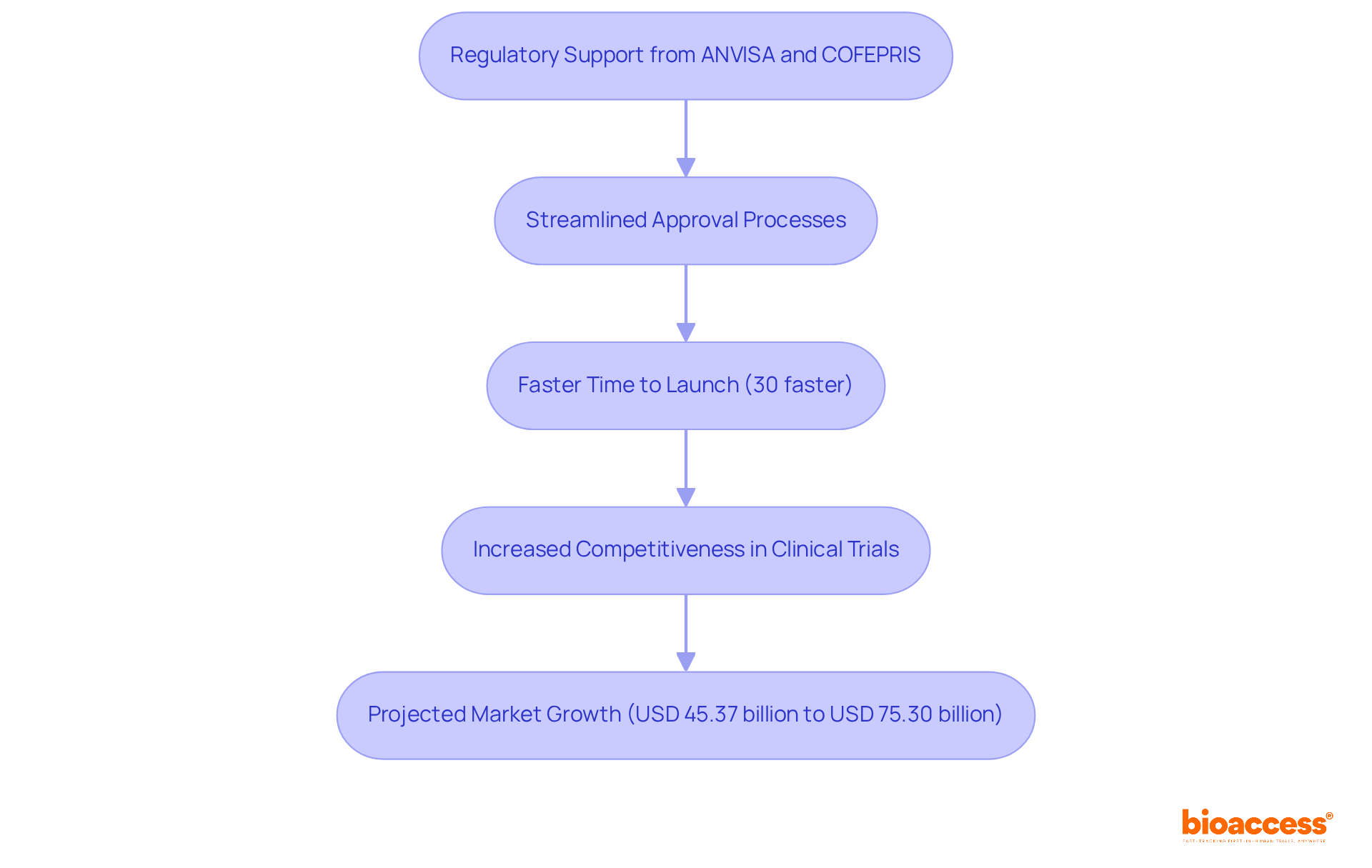
The region of America has witnessed remarkable advancements in regulatory reforms, particularly through agencies like ANVISA in Brazil and COFEPRIS in Mexico. These organizations play a pivotal role in facilitating medtech clinical trials in Latin America by streamlining approval processes. For instance, ANVISA has cut project evaluation deadlines to a maximum of 90 days, significantly boosting regulatory efficiency. This local expertise allows companies to navigate the complexities of regulatory requirements effectively, ensuring compliance and smoother testing processes.
Consider a Medtech company that collaborated with regional distributors; they achieved a 30% faster time to launch by adeptly overcoming compliance challenges. Such regional knowledge is invaluable for Medtech firms looking to enter the market swiftly and efficiently. It not only accelerates the approval timeline but also aligns with the increasing demand in the American medical device market, projected to grow from USD 45.37 billion in 2024 to USD 75.30 billion by 2033.
Regulatory affairs specialists emphasize that support from ANVISA and COFEPRIS is crucial for fostering an environment conducive to medtech clinical trials in Latin America. This collaboration ultimately enhances the competitiveness of studies in the region, paving the way for future advancements in medtech clinical trials in Latin America.
Patient enrollment in the region is notable for its speed in medtech clinical trials in Latin America, often outpacing other areas due to a robust demand for innovative therapies and a community eager to participate in research studies.
Local CROs, such as bioaccess™ in partnership with Caribbean Health Group, employ effective community engagement strategies and leverage established networks to accelerate recruitment. This collaboration achieves enrollment rates that are 40% faster than those seen in the US or EU, positioning Barranquilla as a prime location for medical research in the region.
Supported by Colombia's Minister of Health, who has publicly endorsed this initiative, the efficiency of this approach not only shortens study timelines but also enhances the overall success of research.
With bioaccess® providing expert services, regulatory approval, site activation, and patient recruitment are managed swiftly and effectively.

This area offers a unique environment for implementing flexible research designs in medtech clinical trials in Latin America, particularly adaptive and decentralized methodologies. These approaches enable researchers to make real-time adjustments based on interim data, optimizing resource allocation and enhancing the likelihood of successful outcomes. Such adaptability is vital in the fast-paced Medtech sector, especially in medtech clinical trials in Latin America, where rapid iterations can drive significant advancements in product development.
With bioaccess®, studies can achieve 50% faster patient enrollment for treatment-naive cardiology or neurology groups compared to Western locations. This efficiency translates to $25K savings per patient through FDA-ready data - no rework, no delays. This streamlined process not only accelerates regulatory approval but also boosts the overall efficiency of medtech clinical trials in Latin America, establishing bioaccess® as a leading contract research organization in the region.
In a landscape where collaboration is key, leveraging these innovative methodologies can address the pressing challenges faced in clinical research. As the Medtech sector continues to evolve, the importance of adaptive strategies in medtech clinical trials in Latin America cannot be overstated. Consider how these advancements can transform your approach to clinical trials and drive success.

Medtech clinical trials in Latin America are gaining recognition for their ability to generate high-quality data, driven by a strong commitment to international standards and local regulatory compliance. Notably, recent studies reveal that:
These figures underscore the ethical rigor that characterizes these studies. Furthermore, the region has seen a significant increase in research registration adherence, rising from 19.8% in 2013 to 59.9% in 2015, which enhances the credibility of reported results.
On March 29, 2019, bioaccess™ partnered with Caribbean Health Group to position Barranquilla as a key hub for research studies in Latin America, with support from Colombia's Minister of Health. This initiative aims to attract more health-related research projects to the region. Additionally, GlobalCare Clinical Studies has teamed up with bioaccess™ to enhance ambulatory services in Colombia, achieving over a 50% reduction in recruitment duration and impressive 95% retention rates. Dushyanth Surakanti, Founder and CEO of Sparta Biomedical, shared his positive experience with bioaccess® during its initial human study in Colombia, highlighting the effectiveness of their collaboration.
By leveraging local expertise and established protocols, Medtech companies can trust that their research data from medtech clinical trials in Latin America will meet the stringent requirements of global regulatory bodies. Quality assurance is critical, with 84.3% of registered trials providing a registration number or link in their publications, which boosts transparency and trust in the data produced. This unwavering commitment to quality not only facilitates successful regulatory submissions but also enhances the reputation of medtech clinical trials in Latin America, positioning the region as a formidable player in the global research landscape.

The geographical location of Latin America provides significant strategic advantages for Medtech companies, particularly those engaged in medtech clinical trials Latin America, especially those from North America. Its proximity to the US facilitates seamless communication and logistics, enabling effective coordination of research studies. The alignment of time zones further enhances real-time collaboration, allowing for quicker decision-making and problem-solving. Additionally, the region features a diverse healthcare infrastructure, granting access to a wide range of medical environments. This diversity not only enhances the practicality of conducting studies across various locations but also allows for the inclusion of diverse patient demographics, which is essential for advancing groundbreaking medical technologies.
As bioaccess® emphasizes, their expertise in managing Early-Feasibility Studies, First-In-Human Studies, and other critical experiments ensures that North American firms can navigate the complexities of clinical research in the region effectively. Bioaccess® employs a comprehensive strategy that includes:
to streamline the testing process. Consequently, North American firms are increasingly recognizing the opportunities for medtech clinical trials in Latin America, with many choosing to conduct experiments in countries like Brazil, Mexico, and Colombia, where the regulatory climate is improving and operational efficiencies are on the rise.

Collaborating with local research organizations in Latin America is crucial for enhancing the quality and efficiency of medical studies. These partnerships grant access to established networks and local knowledge, significantly improving process effectiveness. For example, studies show that collaborative teams are 33% more likely to complete projects on time. This statistic underscores the vital role of teamwork in clinical research.
The value of successful partnerships is evident; Colombia's stringent regulatory framework and commitment to ethical standards have attracted numerous international studies. A notable example is ReGelTec's Early Feasibility Study on HYDRAFIL™ for treating chronic low back pain, which ensures a high-quality research environment. Local collaborations not only help in adhering to regulations but also foster community trust, essential for maintaining high participation rates. Industry leaders emphasize that these partnerships enhance research efficiency, ultimately accelerating the development of innovative therapies that improve patient care. Remarkably, collaborations have achieved over a 50% reduction in recruitment time and 95% retention rates, showcasing their effectiveness.
Furthermore, integrating local expertise allows for tailored approaches to diverse patient demographics, enhancing the reliability of study results. This is particularly significant in a region where varied populations present unique health challenges. By partnering with local research organizations, Medtech firms can navigate the complexities of the South American market more effectively, ensuring their medtech clinical trials in Latin America are both efficient and aligned with regional health needs. Dushyanth Surakanti, Founder & CEO of Sparta Biomedical, shared his positive experience with bioaccess during its initial human study in Colombia, further illustrating the benefits of such collaborations.

The Latin American medical device market is on a remarkable trajectory, projected to grow from USD 45.37 billion in 2024 to USD 75.30 billion by 2033, reflecting a compound annual growth rate (CAGR) of 5.79%. This impressive growth is fueled by:
Moreover, the swift adoption of digital health solutions, telemedicine, and AI-driven technologies is significantly shaping this market expansion.
For Medtech firms, this presents a lucrative opportunity to introduce new products and solutions. Engaging in medtech clinical trials in Latin America is not just a strategic move; it’s a pathway to tapping into a rapidly growing market. Bioaccess stands out with its expertise in managing:
This enables companies to navigate the complexities of clinical trials with confidence.
As the landscape evolves, listening to consumer preferences and adapting strategies will be essential for successful market entry in this dynamic environment. Are you ready to seize the opportunities that lie ahead? Collaboration and strategic planning will be key to thriving in this burgeoning sector.

The advantages of conducting medtech clinical trials in Latin America are not just compelling; they are essential, underscoring the region's growing significance in the global research landscape. With accelerated ethics approval timelines, cost-effective solutions, and access to diverse patient populations, Latin America emerges as a strategic hub for innovative medical research. The commitment to regulatory excellence and collaboration with local research institutions further enhances the region's appeal, ensuring that trials are not only efficient but also yield high-quality data.
Key insights illustrate how Latin America stands out for its rapid patient recruitment processes, flexibility in trial design, and strategic geographical location. These factors contribute significantly to successful clinical outcomes. The projected growth of the medtech market in this region underscores the urgency for companies to engage in clinical trials here, allowing them to capitalize on the burgeoning demand for healthcare innovations.
In light of these benefits, stakeholders in the medtech industry must explore the opportunities presented by Latin America. By leveraging the region's unique advantages, companies can enhance their research capabilities and contribute to the advancement of healthcare solutions that are accessible and effective for diverse populations. Embracing this potential is not just beneficial; it is essential for staying competitive in an ever-evolving market landscape.
What are the typical ethics approval timelines for clinical trials in Latin America compared to the US and EU?
Ethics approval timelines in Latin America can be as short as 4-8 weeks, whereas in the US and EU, they typically range from 3-6 months.
What factors contribute to the rapid ethics approval process in Latin America?
The rapid approval process is driven by streamlined regulatory frameworks, such as those governed by INVIMA, and a strong commitment to enhancing research efficiency.
How does conducting clinical trials in Colombia compare to North America and Western Europe in terms of cost?
Clinical trials in Colombia can result in savings of over 30% compared to trials in North America or Western Europe.
What financial incentives does Colombia offer for companies investing in medical research?
Colombia offers R&D tax incentives that provide substantial financial benefits for companies involved in medical research.
How does the healthcare system in Colombia enhance its appeal for clinical trials?
Colombia's healthcare system is ranked among the best globally, which boosts its attractiveness for conducting research trials.
What are the estimated average costs for research studies in Latin America in 2024?
The average expense of research studies in Latin America is projected to be around $1.5 million per project in 2024.
What advantages do Latin American countries offer in terms of patient diversity for clinical trials?
Latin America provides access to a diverse range of patient populations, which is essential for gathering data that reflects varied responses to treatments across different demographics.
Which countries in Latin America account for the majority of research activities related to medtech clinical trials?
Brazil, Argentina, and Mexico together account for 70% of the region's research activities in medtech clinical trials.
How does the urban population in Brazil and Mexico facilitate participant recruitment for clinical trials?
Over 80% of the populations in Brazil and Mexico reside in urban areas, presenting unique opportunities for recruiting participants from varied backgrounds for clinical trials.
What is the significance of engaging diverse ethnic backgrounds in clinical trials in Latin America?
Engaging diverse ethnic backgrounds enhances the relevance of study outcomes, fosters trust within communities, and ultimately leads to better health equity and more effective treatments for all populations.